.png)

Habit Formation: How to Build Good Habits That Actually Stick
Think about the last habit you tried to build. Maybe it started with real energy — a new routine, a fresh plan, a promise to yourself that this time would be different. For a few days, maybe even a couple of weeks, it worked. Then life got busy. Motivation dipped. And slowly, without a clear moment of failure, it just… stopped.
If that sounds familiar, it's not because you lack discipline. It's because most habits are designed backwards. We focus on intensity instead of structure, motivation instead of environment, and willpower instead of systems.
The good news is this: lasting habits aren't built through big bursts of effort. They're built through small, repeatable cues that make the right action feel almost automatic.
This guide walks you through how to build good habits that actually stick — not by becoming a different person, but by setting things up so consistency becomes the easier option. Everything here comes back to one idea: successful habit formation is about design, not willpower.
What you'll learn applies to almost any kind of behaviour change — from morning routines to how you spend your evenings. By the end, you'll understand how habits form, how long it really takes, and you'll have a simple system for building habits that fit into real life, plus practical tools you can start using today.
What is a habit, really?
A habit is a behaviour your brain has learned to automate — the result of slow, steady habit formation over time. It's something you do without needing to decide to do it every time.
That's the key difference most people miss: habits don't rely on motivation in the moment. They rely on repetition and cues that remove the need to think.
Why do habits matter more than motivation?

Motivation is unreliable. Habits aren't. That's why behaviour change rooted in habit is far more sustainable than behaviour change rooted in willpower.
Here's what changes when you build strong habits:
- You stop negotiating with yourself. Instead of deciding every day whether to do something, it just becomes part of your rhythm.
- You reduce decision fatigue. Fewer choices mean more mental space for things that actually matter.
- You create momentum without effort spikes. Progress stops depending on “good days” and starts happening on normal days.
- You build identity through repetition. Every time you follow through, you’re reinforcing a quiet belief: “this is who I am now.”
Research in behavioral science consistently shows that consistency matters more than intensity. Small actions repeated often outperform big actions done occasionally — not because they're easier, but because they're sustainable.
How the habit loop works
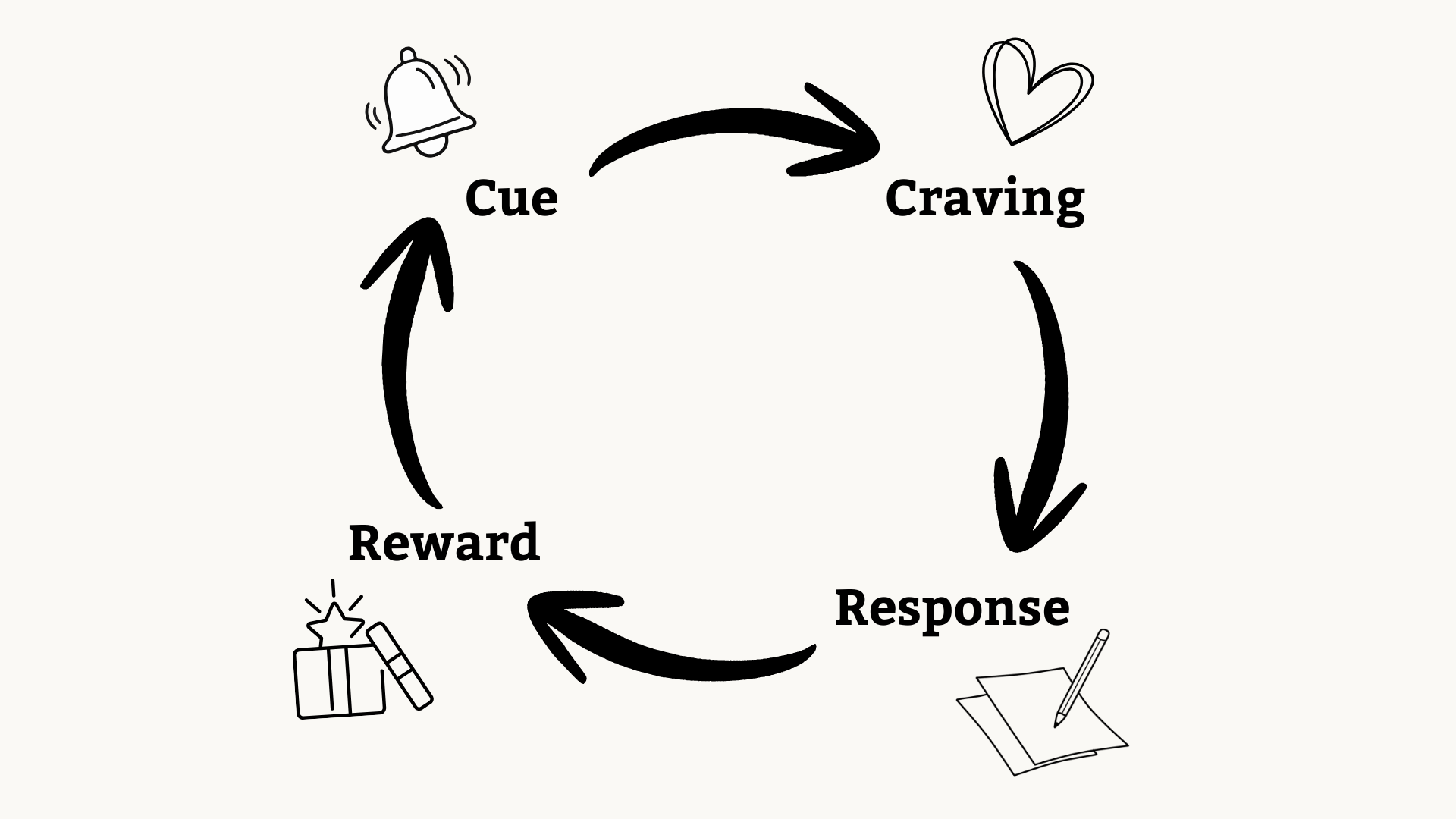
Most habits follow the same simple habit loop — a four-part cycle that explains how behaviours become automatic. The four-part cycle:
- A cue (something that triggers the behavior), such as: I sit at my desk in the morning
- A craving (the motivation or desire that the cue creates), such as: I want to feel focused and like I’ve started the day productively
- A response (the action you take), such as: I write for 10 minutes
- A reward (what your brain gets from doing it), such as: I tick it off and enjoy my coffee break
Over time, your brain starts to link the cue with the reward so strongly that the behaviour becomes automatic. Understanding the habit loop is what lets you design habits deliberately instead of hoping they form by accident.
That's why brushing your teeth doesn't require willpower, but starting a new workout routine does. One is wired into a loop. The other is still floating in intention.
How long does it take to build a habit?
This is the question almost everyone asks, and the honest answer isn't the one you've probably heard. You may have been told it takes 21 days — but that figure is a myth, traceable back to a 1960s observation about plastic surgery patients, not habit research.
In reality, there's no single magic number. How long it takes depends on the person, the habit, and how complex the behaviour is — a simple habit like drinking a glass of water each morning sets in far faster than a daily workout. As a realistic rule of thumb, plan for somewhere in the range of a couple of months of steady repetition before a habit feels genuinely automatic, with simpler habits landing sooner and harder ones taking longer.
There are two takeaways that matter for how to build a habit:
Be patient through the early weeks. The first two to three weeks are the hardest, when the behaviour still feels effortful. That's normal, not a sign you're failing.
Missing a day doesn't reset the clock. One slip won't undo your progress. Consistency over weeks matters far more than a perfect, unbroken streak.
So if you're wondering how long it takes to build a habit, expect it to take a while — often a couple of months — and don't panic on the days you slip.
How to build good habits in 6 steps

This is a simple system you can use for almost any habit — from exercising to reading to drinking more water or reducing screen time. Follow these steps and you'll have a repeatable method for how to build better habits that last.
Step 1: Start smaller than you think you should
Most habits fail because they start too big. "I'll work out for an hour every day" sounds strong, but it often collapses under real life.
Instead, ask: "What is the smallest version of this habit I could do even on a bad day?"
Examples:
- Instead of 1 hour workout → 5 push-ups
- Instead of reading 1 hour → 2 pages
- Instead of journaling deeply → 1 sentence
This isn't lowering the standard. It's increasing the probability of showing up. Because once you show up, you can always do more — but you can't scale something you never start.
Step 2: Use habit stacking to anchor it to something you already do
Habits stick better when they’re anchored to existing routines.
What is habit stacking?
Habit stacking is the technique of linking a new behaviour to something you already do automatically, so the existing habit becomes the cue for the new one. It's one of the most reliable techniques in habit formation because it removes the hardest part of any new habit: remembering to do it.
Instead of "I will meditate every day," try: "I will meditate after I brush my teeth in the morning."
Instead of "I will drink more water," try: "I will drink a glass of water after I make my morning coffee."
The existing habit becomes the cue. No extra thinking required. Once you understand what habit stacking is, you can chain almost any new behaviour onto a routine you never skip.
Step 3: Make it visible and obvious
If you have to remember your habit, you're already working against yourself. Your environment should remind you.
Examples:
- Leave your book on your pillow
- Put your gym clothes next to your bed
- Keep water on your desk instead of in the fridge
- Put your journal beside your laptop
You're not trying to be more disciplined — you're trying to make the right action the easiest one to see.
Step 4: Remove friction from starting
Most resistance happens at the start, not during the habit itself. So the goal is simple: make starting almost effortless.
Ask: What makes this harder to begin? What can I remove?
Examples:
- Pre-set workout clothes the night before
- Use a default app blocker for distractions
- Keep your workspace already set up
- Reduce choices ("same time, same place")
The less energy it takes to begin, the more likely you are to follow through.
Step 5: Focus on repetition, not perfection
A habit doesn't need to be perfect. It just needs to be repeated. Missing one day doesn't break a habit. What breaks it is the story you tell yourself after missing it.
Instead of "I missed a day, so I've failed," shift to: "I missed a day, so I return to it today."
Think in terms of identity reinforcement: one action builds it, one miss doesn't erase it. Consistency is built in recovery, not perfection.
Step 6: Track it in the simplest way possible
Tracking is not about pressure. It's about visibility. If you can see progress, you're more likely to continue.
Keep it simple:
- A checkbox on paper
- A streak on your calendar
- A note in your phone
- A habit tracker app (if you like structure)
The point isn't data. It's awareness. Seeing "I showed up 4 times this week" is far more powerful than guessing how you did. You just need to look.
Tools that help habits stick
You don't need complex systems, but a few simple tools can make consistency easier.
A habit tracker. A visual tracker keeps your streak visible. It turns effort into something you can see, not just feel.
Environmental design. Your space is one of the strongest behaviour influencers you have. Shape it so good habits are obvious and bad habits are slightly inconvenient.
A "minimum version" rule. Decide in advance: "If I'm tired, I still do the smallest version." This prevents all-or-nothing thinking from breaking momentum.
Tips for when you fall off
Everyone does. The difference is what happens next, and it's where most people learning how to build better habits go wrong — they treat one slip as total failure.
Go back to the smallest version. Not the full plan — just the entry point.
Reconnect with your cue. Make starting easy again.
Avoid restarting "perfectly." Restart simply.
Most habits don't fail because you stop. They fail because restarting feels too heavy.
A final thought
If there's one shift to take from this guide on how to build good habits, it's this:
You don't build habits by forcing consistency. You build them by designing for inevitability.
The goal isn't to be more disciplined. It's to make the right action the path of least resistance. Start smaller than you think. Anchor it to something real with habit stacking. Make it obvious. Repeat it enough times that it stops feeling like effort.
And if you're building something new this week, don't aim for perfect consistency. Aim for the first repetition. That's how to build habits that actually last — one quiet, repeatable choice at a time.
That's where everything begins.