.png)

Side Hustles for Beginners: How to Make Money Online from Home
You've seen the posts. Someone on Instagram claims they made $4,000 last month working several hours a day from their couch. A YouTube guru promises you can quit your job in 90 days with one simple trick. And somewhere in the back of your mind, a quieter, more honest question keeps surfacing: is any of this actually real?
The answer is: yes — but not quite like that.
Real people are genuinely building extra income online from home in 2026. Not overnight, not passively, and not without some effort. But the barrier to starting has never been lower. You don't need a business degree, startup capital, or technical skills. You need a clear idea, a realistic plan, and the willingness to stick with it past the first frustrating month.
This guide is for complete beginners who want to know how to make money online — and specifically how to make extra money without turning their life upside down. By the end, you'll know exactly what a side hustle is, how to pick the right one for your life, and which opportunities are actually worth your time — with real earning figures, not fantasy.
What is a side hustle, really?
A side hustle is any income you earn outside your main job, on your own terms. It's work you control — when you do it, how much you take on, and what you charge.
That's different from a part-time job, where someone else sets your schedule and your rate. A side hustle is yours.
In 2026, the vast majority of side hustles happen online. Learning how to make money from home has never been more accessible — all you need is a laptop and an internet connection. And increasingly, AI tools mean you can deliver work faster and at higher quality than ever before, even if you've never freelanced a day in your life.
A few things a side hustle is not:
- It's not a get-rich-quick scheme. Most beginners earn between $200 and $800 a month in their first six months. That's real, meaningful extra money — but it won't replace your salary next week.
- It's not passive (at least not at first). Almost every successful side hustle starts with active work: pitching clients, creating products, building an audience.
- It's not a second full-time job. The best side hustles fit into the gaps of your existing life without burning you out.
Why now? Because the cost of living has outpaced wage growth in most countries. Between 2020 and 2024, wages grew 18% on average — but inflation rose 21%. That gap is why 72% of working adults now rely on at least one source of secondary income. Starting a side hustle isn't an unusual choice anymore. It's a sensible one.
How to pick the right side hustle: 3 questions to ask yourself
The biggest mistake beginners make is trying three ideas at once and building none of them properly. Before you start looking into ways to make extra money, answer these three questions honestly.
1. What do you already know or do well?
Your fastest path to your first dollar is through skills you already have. A teacher can tutor or write educational content. Someone with years of admin experience can offer virtual assistant services. A person who has worked in marketing can manage social media for small businesses. You don't need new skills to start — you need to package the ones you already have.
If you genuinely feel like you have nothing to offer, don't worry. Many of the options below require no prior expertise, just a willingness to learn a tool.
2. How many hours per week can you realistically commit?
Be honest. If you have two to five hours a week, you need a side hustle that produces results in small bursts — freelance services and digital product sales work well. If you have ten or more hours, you can pursue something with a longer build time, like a content channel or online course.
Overcommitting is how people quit in month one.
3. Do you want to trade time for money, or build something that scales?
Service-based side hustles — writing, tutoring, design, admin work — pay you for the hours you put in. They're faster to start and easier to get your first client. Digital product side hustles — templates, courses, prompt packs — take longer to build but can earn money while you sleep once they're set up.
Neither is better. The right answer depends on what you need right now.
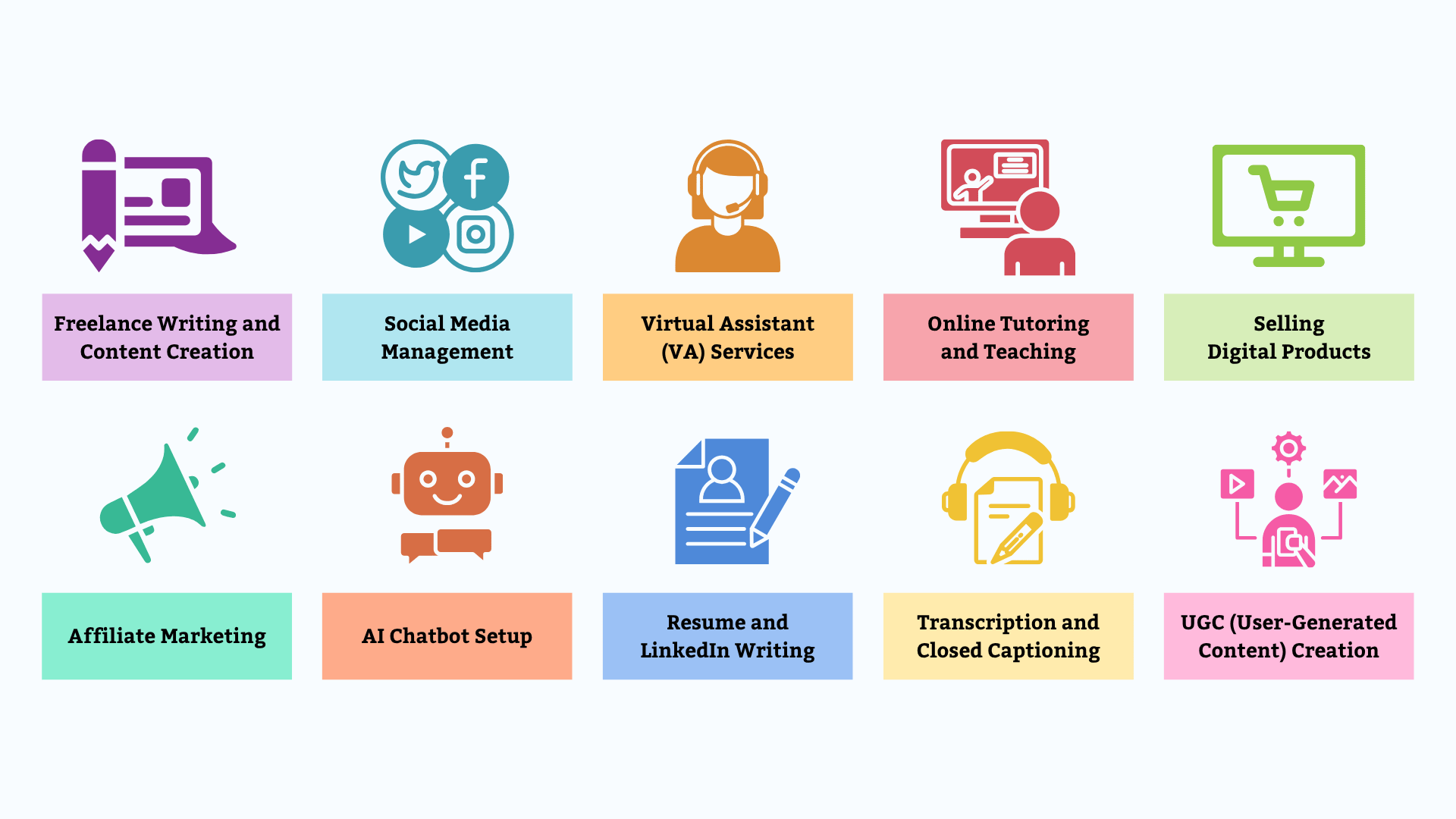
10 beginner-friendly ways to make money online from home
There's no shortage of ways to make extra money online — but not all of them are worth your time as a beginner. The ten below are chosen for low barriers to entry, realistic earning potential, and the ability to run them entirely from home.
1. Freelance writing and content creation
Businesses need a constant supply of blog posts, email newsletters, social captions, and website copy — and most of them can't afford to hire a full-time writer. That's where you come in.
In 2026, AI writing tools like ChatGPT and Claude have made it easier than ever to produce polished drafts quickly. But here's the thing most beginners miss: businesses aren't paying for AI output. They're paying for a human who understands their audience, knows their tone, and can turn a rough brief into something worth reading. AI is your assistant, not your replacement.
Where to start: Fiverr and Upwork for your first clients; LinkedIn and direct pitching once you have a portfolio. Pick one niche — fitness, finance, tech, food — and write three sample pieces to show what you can do.
2. Social media management for small businesses
Most small businesses know they should be posting consistently on Instagram or Facebook. Almost none of them have the time to do it. If you can create a content calendar, write captions, design basic graphics in Canva, and schedule posts, you have a marketable service — and a solid way to make money from home on a flexible schedule.
AI tools have made this dramatically more scalable. You can batch-create a month's worth of content for a client in a few hours, meaning you can realistically manage three to five clients alongside a full-time job.
Where to start: Cold email or message five local businesses you follow on social media. Show them what their profile could look like with three sample posts you've already created for them.
3. Virtual assistant (VA) services
A virtual assistant handles the administrative tasks that business owners and entrepreneurs don't have time for: inbox management, scheduling, data entry, research, customer service replies, expense tracking. The work is familiar if you've ever held an office job — it just happens remotely.
VA work is one of the easiest side hustles to land your first client in, because the service is so clearly useful and the barrier to entry is low. Specialising increases your rate significantly: a general VA earns $15–$25 per hour, while one who specialises in a specific tool or industry can charge $35–$60.
Where to start: Upwork and Belay for your first clients. Consider specialising in a tool you already know — Notion, Asana, or HubSpot.
4. Online tutoring and teaching
If you know something well — a school subject, a language, a software, an instrument, a skill — someone will pay you to teach it to them. Online tutoring has expanded well beyond academic subjects. People hire tutors for Excel, public speaking, coding basics, interview preparation, and everything in between. It's one of the most straightforward ways to make extra money from skills you already have.
Where to start: Preply and iTalki for language tutoring; Tutor.com and Wyzant for academic subjects; direct bookings via your own social media for skill-based teaching.
5. Selling digital products
Digital products — templates, guides, printables, spreadsheets, prompt packs — are created once and sold an unlimited number of times. They're the closest thing to genuine passive income for beginners, and one of the most popular ways to make money online from home because there's no inventory, no shipping, and no client calls required.
The key to selling digital products is specificity. "A Notion template for freelancers tracking multiple clients" will consistently outsell "a general productivity template." Solve one specific problem for one specific person.
Where to start: Etsy and Gumroad for hosting your products; Canva for creating templates and guides.
6. Affiliate marketing through a blog or social channel
Affiliate marketing means earning a commission when someone buys a product through your unique link. You don't handle shipping, customer service, or inventory — you just create content that genuinely helps people make a decision, and earn a cut when they buy. It's one of the few ways to make money online that can grow into something largely hands-off over time.
This takes the longest of anything on this list to generate meaningful income. Most bloggers don't see significant earnings until their site is twelve to eighteen months old and attracting consistent organic traffic. But for those who stick with it, the ceiling is high: the global affiliate marketing industry is valued at $18.5 billion in 2026.
Where to start: Choose a niche you know and enjoy. Set up a blog on WordPress or start a niche TikTok or YouTube channel. Join affiliate programmes like Amazon Associates, ShareASale, or Awin.
7. AI chatbot setup for local businesses
This is one of the most underrated side hustles for non-technical beginners in 2026. Local businesses — salons, clinics, gyms, restaurants — are increasingly aware that they should have an AI chatbot handling customer enquiries on their website or WhatsApp. Almost none of them know how to set one up.
No-code tools like Tidio, Voiceflow, and Botpress let you build functional, professional chatbots through drag-and-drop interfaces and plain-English configuration. You don't write code. You learn the tools (a few days of practice is enough), then charge businesses for the setup and a monthly maintenance fee.
Where to start: Build one demo chatbot for a fictional business to show as your portfolio. Then reach out to five local businesses that have slow or non-existent website response times.
8. Resume and LinkedIn writing
With 49% of workers anxious about job security and AI disruption in 2026, demand for career document services is surging. People know they need a strong resume and LinkedIn profile — they just don't want to write them.
This is one of the fastest side hustles to earn your first $100, and one of the simplest ways to make extra money if you're a strong writer. You can take on your first client within a week of deciding to start, with nothing but good writing skills and a clear service offer.
Where to start: Offer your services to three people in your network for free or at a reduced rate in exchange for testimonials. Then list on Fiverr and promote on LinkedIn.
9. Transcription and closed captioning
Transcription services — converting audio or video files into written text — are in steady demand from researchers, podcasters, legal firms, and content creators. AI transcription tools handle the first pass; your value is accuracy, formatting, and quality control.
It's repetitive work, but it requires no prior experience, no client pitching, and no portfolio. For anyone figuring out how to make money from home with the absolute minimum barrier to entry, this is one of the most reliable starting points. You can start earning within days of signing up to a platform.
Where to start: Rev.com and TranscribeMe.
10. UGC (User-Generated Content) creation
Brands increasingly want authentic, real-person content rather than polished ad campaigns. UGC creators film short product demonstration videos, unboxings, and testimonials — which brands then use in their own ads. You don't need a large following. The brand runs the ads, not you.
Rates have matured significantly: $50–$150 per video for beginners is standard, with packages running considerably higher for experienced creators. All you need is a decent smartphone, good lighting, and the ability to speak naturally on camera. It's one of the more creative ways to make extra money online, and it's growing fast.
Where to start: Build a portfolio of three to five demo videos for products you already own. Then pitch to brands directly on Instagram or join platforms like Billo and JoinBrands.
How much can you realistically earn?
Here's an honest breakdown based on what the data actually shows in 2026:
The most important number on that table is the first one. Expect nothing for the first few weeks. Most people quit because they try a side hustle for a month, earn little, and assume the opportunity isn't real. What's actually happening is normal: you're building skills, getting feedback, and finding your footing. Stay in it.
5 mistakes beginners make (and how to avoid them)
Starting three things at once. Pick one. Every piece of research on what makes side hustles succeed points to the same failure mode: spreading too thin, building nothing properly, and getting no clients in the first thirty days. One focused offer outperforms three half-built ones every time.
Waiting until everything is ready. Your website doesn't need to be perfect. Your portfolio doesn't need five pieces. Send the pitch with what you have. You'll improve faster from real feedback than from endless preparation.
Underpricing for too long. Charging low rates to land your first client is reasonable strategy. Still charging those rates six months later is not. Raise your prices after your first three to five positive engagements.
Ignoring taxes on side income. In most countries, earnings from side hustles are taxable. Keep records from day one, even if it's just a simple spreadsheet. You don't need an accountant at first — you just need to not be surprised at tax time.
Quitting at thirty days. Most side hustles need sixty to ninety days to gain any real traction. A month of effort with modest results is not a sign the idea doesn't work. It's a sign you're still in the warm-up.
Where to go from here
You've read the guide. Now the only thing that matters is doing one thing today — not tomorrow, not after you've done more research.
Look back at the ten ways to make money online from home above. Find the one that best matches what you already know, the time you actually have, and whether you want something fast or something that scales. Then do the first concrete step: set up a profile, write your first sample, build your demo.
The people who succeed with side hustles aren't unusually talented or lucky. They're the ones who started with something imperfect and kept showing up.
That can be you.







.png)